
The 1980’s brought new technological innovations to McDermott’s manufacturing processes. CNC turning centers made cues more consistent. Inlays became more complex and tighter-fitting thanks to 4-axis rotational milling. And lithographic transfer printing allowed cues to be adorned with fantastic works of art.
Lithography, a combination of the Greek words for ‘stone’ and ‘to write,’ is a process of reproducing text and artwork by applying ink to stones – replaced in the modern era by metal plates – and then transferring it to paper, one color at a time. It was invented in the late 1700s by a German author as a cheap way for him to publish his work, but quickly picked up steam as a way to reproduce great works of art.
In the mid-1980s, Larry Liebl, then McDermott’s production manager, had an idea: why not use this technique to print full-color images on pool cues? It would allow lower priced cues to be just as lively and colorful as much more expensive inlaid cues. His idea would result in some of the company’s most successful cues, but success wouldn’t come overnight.
No one had done this before. The process of perfecting the technique for use by McDermott took two years and required the help of two different printing companies working together. The white-backed transfer paper on which the art was reproduced was far less permeable than the paper normally used in the lithographic process. The printers had to find a way to keep ink from pooling on top of the paper and smearing, while still maintaining the vivid colors McDermott demanded.
Eventually, these issues were worked through and it was time to put this new technique to good use. Several artists produced artwork for cues that would make their way into 1990’s E Series. Noted Wisconsin wildlife artist Terry Doughty created scenes of deer, eagles, wolves and more. Wes Spencer, originally hired to work machines in the factory, contributed works showing both the mundane and the fantastic; everything from the tip of a cue hitting a ball, to a wild west saloon. Several other artists, many of them from McDermott’s native state of Wisconsin, also had works appear on cues.
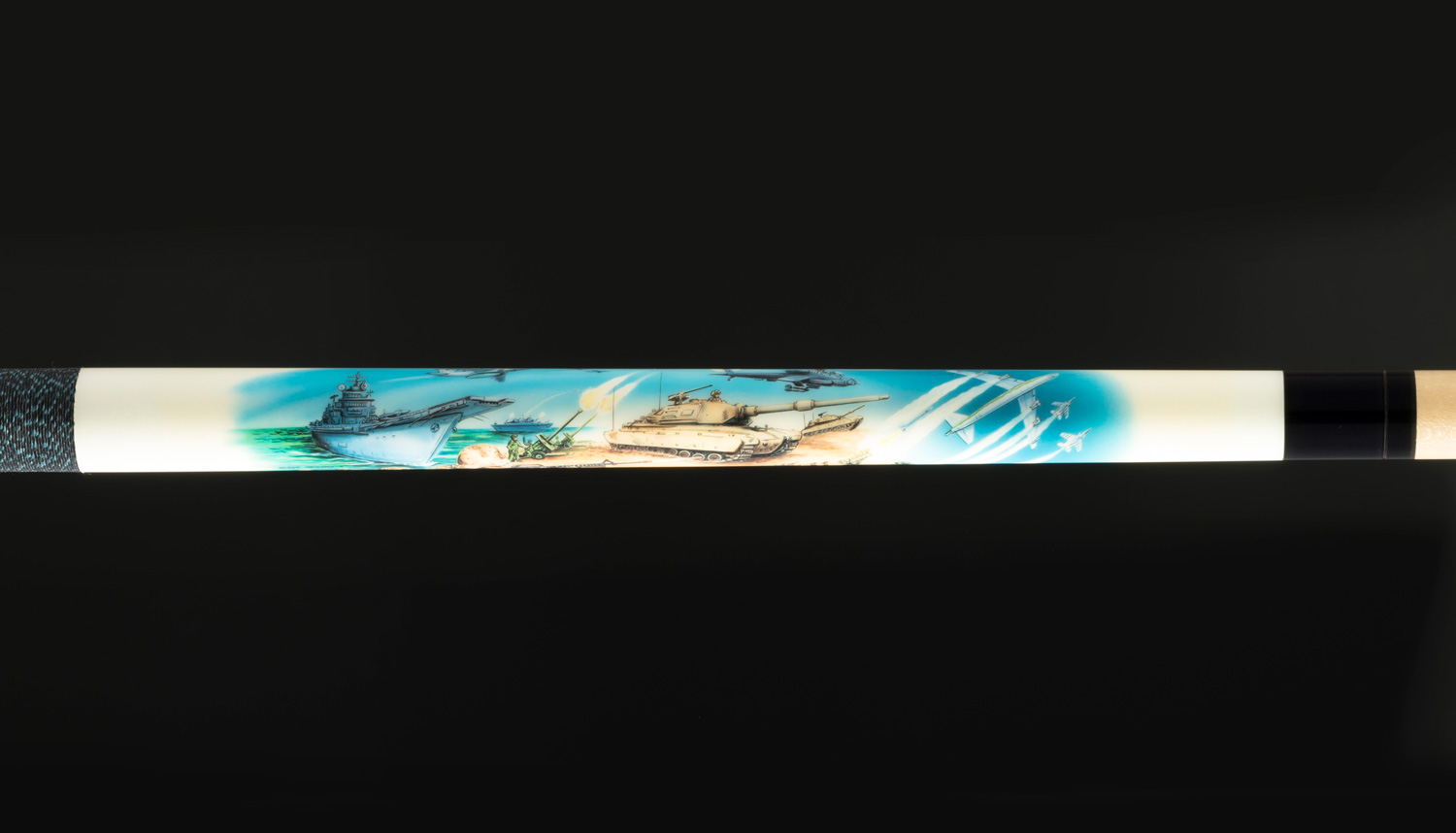
Among these cues was a special work created to honor the U.S. Armed Forces. Dubbed the “Freedom Cue,” the sleeve featured a bald eagle holding a pair of American flags, while the forearm was covered in scenes reminiscent of the recent Operation Desert Storm. The artwork was created by artist Blaine Heilman, who had gained notoriety after his works appeared on neckties. For each “Freedom Cue” sold, McDermott donated $5.00 to The Disabled American Veterans, a non-profit organization.
A plethora of new images were created for 1997’s launch of the M Series of cues. These included cues that would remain incredibly popular even today: the M2WW “Wolf” and M2WE “Eagle” cues. New transfer art cues would continue to be introduced during the M Series run; however, the popularity of the form would begin to wane in the mid-2000s. The launch of the G Series in 2010 largely signaled the end of lithograph artwork appearing on catalog-model McDermotts.
Although the McDermott factory may no longer be producing transfer artwork cues on a regular basis, the popularity of the E and M series transfer artwork cues ensures that the McDermott restoration team routinely sees them for a variety of services. It’s important that owners of these cues take very good care of them, as it is impossible to refinish one without replacing the old artwork. Original artwork for many of these cues is no longer available however, so supplies of replacement transfers are limited.
The ability to add lithographic transfer artwork to cues resulted in a new look for pool cues. Vivid colors and details painted scenes that would never be possible with inlays, all at a fraction of the cost of even simple inlay patterns. They may not garner the same attention on the secondhand market that intricately detailed inlay cues do, but that hasn’t stopped many players from appreciating these cues.
Wow, absolutely amazing what you can do with putting art on pool cues. It be amazing to have a contest where the winner can get the piece of artwork of their choice on a McDermott Cue.
I remember these cues. I had the one with the cowboy riding the 9 ball. I used it for like 10 yrs then It was stolen…I was highly upset.
I had the Tiger cue for awhile and people really noticed it. It had the different sleeve.
I want one…just starting to play the pool game…and I love it!!
Great article, I always wondered about how the artwork was done on sticks, decals came to mind but figured they were too fragile, now I know.
Will you be releasing any of those cues or are any of them available? The E-l1 is what im looking for
A few are available, but the E-L1 is not one of them. Unfortunately, most of these cues will never be made again. Only a certain number of transfers were made, and the artwork has either been lost since or is no longer available due to licensing/copyright issues.
I have recently grown very fond of these McDermott cues , and have managed to procure several.
Among them the “Dueling Panthers” , pictured at the head of this article. Also the “Bengal Tiger” , also mentioned in the article and recently the “Arctic Wolf”.
I don’t regularly play these cues , but when I do they actually perform as they should.
Nice article. Thanks
You are welcome. Nice collection.
I have the snow leopard and the wolf. The que’s are alway attention grabbers.
have two McDermott cues, wondering if they are worth anything
one: purple with a black panther on it
two: eagle with an American flag, whte
thanks
Patrick, we don’t track values of old cues. Try asking on a forum like the one at azbilliards.com.
Love the article about these cues. I’ve had two of these cues. I’ve got the M2WW the Arctic Wolf and the E-L1 Lone Wolf on a Blue backing and they are in Very Very good condition. I had McDermott service them not to long ago and also had them make a second shaft made for each of theses cues. There is a section here on the website that does have a value of these cues. The section is the MecDermott Cue then look for retied cues. I’ve have Four McDermott cue from a D-9 M2WW, E-L1 models to my G218 engraved Wolf which is the one I use the most but has been replaced with the G338 engraved Wolf now. If you own any McDermott cues don’t for get to register them new and old.
Why isn’t there one with a white buffalo the true spirit of America